
Guide updated · Editorial responsibility: BedBugChina
Travel field guide · Original directory analysis
Bed Bugs in China: A Traveler’s Guide
What 330 public pest reports can tell you before your next hotel stay.
Travelling in China? Check the exact property before booking, inspect the sleeping area before unpacking, and keep your belongings contained if you find suspicious signs. A public report can tell you what someone reported at a particular place and time. It cannot tell you the chance of encountering bed bugs on your trip.
This guide is for independent travellers, visiting families and anyone navigating Chinese hotel listings. It combines BedBugChina’s public records with practical guidance from the US Environmental Protection Agency, the US Centers for Disease Control and Prevention, and Health Canada.
November 1 update: check the current city file before booking
A separate November 1, 2026 snapshot contains 497 published pest reports at 406 properties; 246 reports carry the bed bug label. This is a larger collected directory, not evidence of more recent incidents or rising infestation rates. The original analysis and three figures below still use the October 27 snapshot of 330 reports.
| City | Properties | All pest reports | Bed bug-labelled |
|---|---|---|---|
| Shanghai | 50 | 66 | 46 |
| Beijing | 50 | 68 | 44 |
| Guangzhou | 13 | 15 | 10 |
| Shenzhen | 15 | 21 | 10 |
Open your destination above, match the Chinese branch name and address, then read the event date, source and any published property response. City files can change after this snapshot. For a direct property lookup, search the hotel records.
November 1 statistics and methods (JSON) · November 1 tables (CSV). Captured from the public API. The inclusion rules and limitations are explained in Methods.
What our China hotel pest reports actually measure
Our October 27, 2026 snapshot contains 330 published reports at 308 properties. A report is one database record, rather than one room, one affected traveller or one independently confirmed infestation. Some properties have multiple reports; different accounts may describe the same incident.
The stored pest labels matter. Alongside 102 bed bug-labelled records, this snapshot contains 34 cockroach-labelled records and 172 in the “other” category, plus smaller groups such as fleas and rove beetles. “Other” does not mean “probably bed bugs.” A rash or an unidentified insect should remain uncertain.
There are 108 third-party public leads and 222 records stored under the guest-submission source type. That is the database’s source classification, not an independent audit of every account’s origin. 327 records carry an unverified evidence label. The other 3 carry stay-proof review labels; reviewing a stay does not establish the insect species or the reported event.
Why use a directory with these limits? It gives you specific questions to ask: Is this the right branch? When was the reported stay? Is an insect visible? Has the property responded? Read the source and moderation policy, then use the public record directory to examine individual histories.
Which cities have the most reports in this dataset?
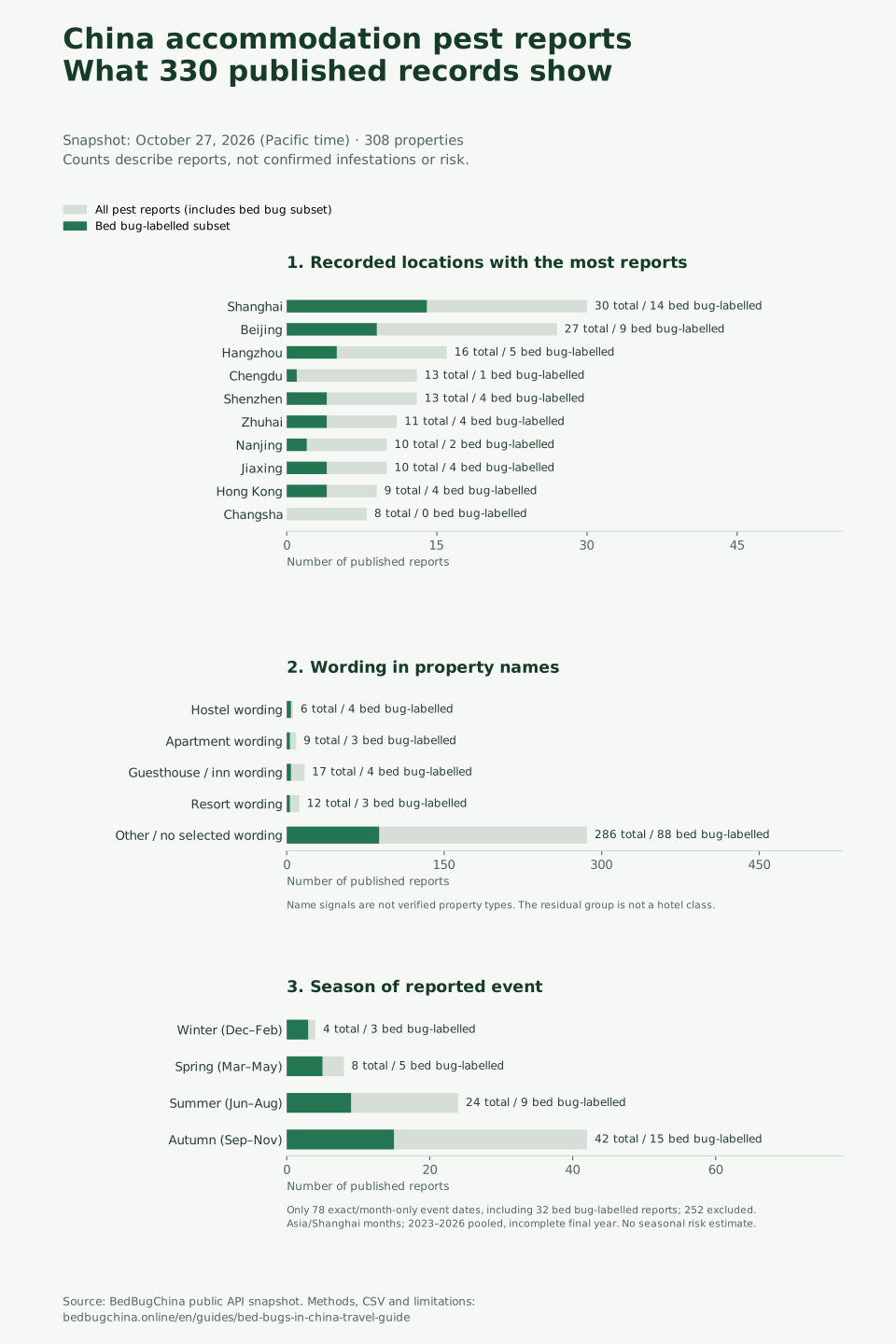
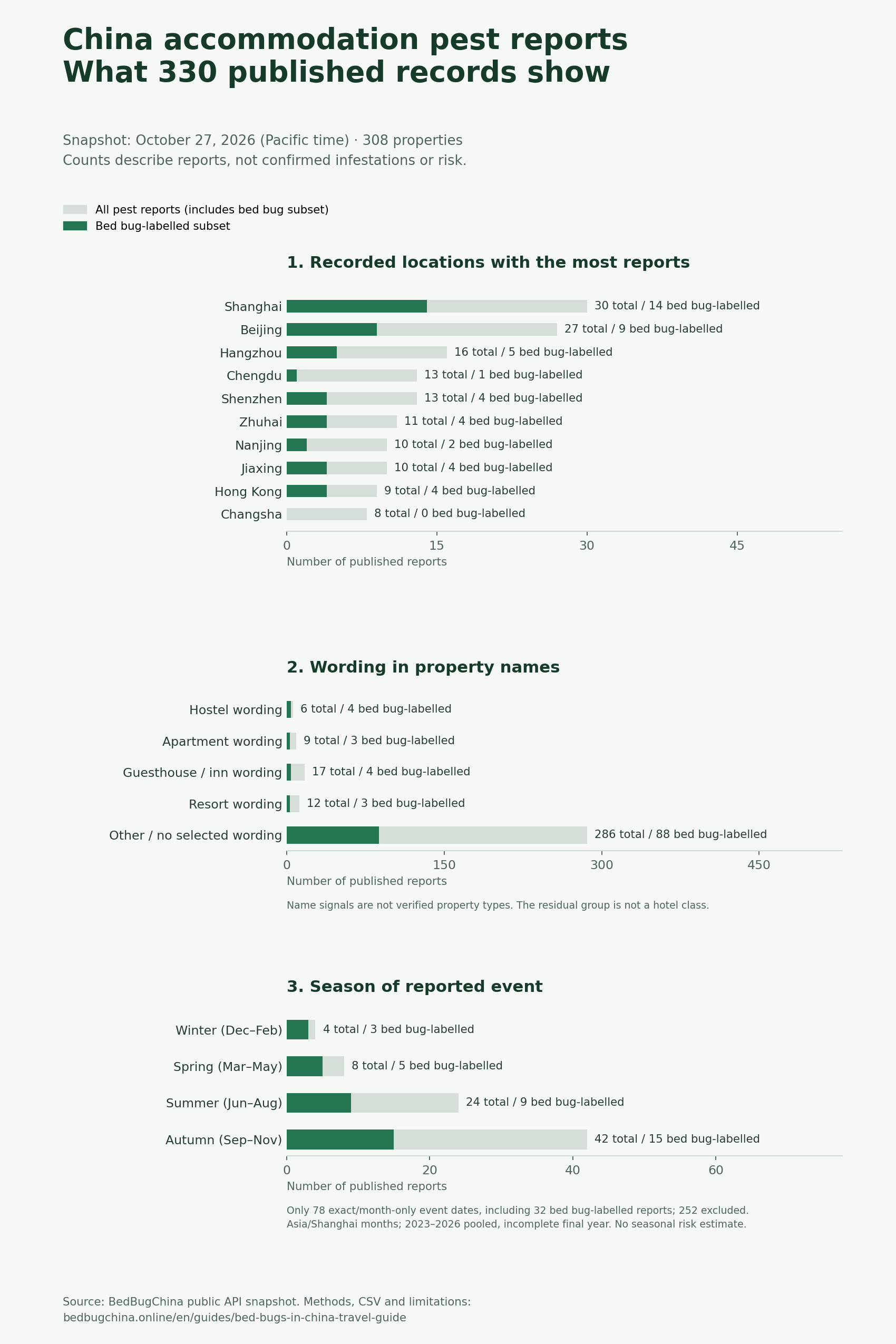
Shanghai leads this snapshot with 30 public pest reports, followed by Beijing with 27 and Hangzhou with 16. Within those totals, 14, 9 and 5 records respectively are labelled bed bugs. The chart keeps the broader pest total separate from its bed bug-labelled subset.
All pest reportsBed bug-labelled subset
| Group | Reports | Bed bugs |
|---|---|---|
| Shanghai | 30 | 14 |
| Beijing | 27 | 9 |
| Hangzhou | 16 | 5 |
| Chengdu | 13 | 1 |
| Shenzhen | 13 | 4 |
| Zhuhai | 11 | 4 |
| Nanjing | 10 | 2 |
| Jiaxing | 10 | 4 |
| Hong Kong | 9 | 4 |
| Changsha | 8 | 0 |
A larger count can reflect more travellers, more searchable posts, more submissions or more collection activity. We do not know the number of occupied hotel nights behind each city’s records. Without that denominator and a representative collection method, “more reports” cannot become “more dangerous.”
Use the city links to check properties and dates. For a trip spanning several stops, also browse Guangzhou, Shenzhen and Hong Kong. A city or hotel absent from the directory has not been assessed as free of bed bugs.
Hotels, hostels or apartments: which types appear most?
We cannot responsibly compare budget hotels with luxury hotels from these records. The database has no consistent star rating, room price or verified accommodation-type field. Assigning those classes from brand reputation would add assumptions to the results.
We can make a narrower comparison using words in the stored Chinese property name. The groups below identify hostel, apartment, guesthouse or inn, and resort wording. Each property enters one group; names matching none of those chosen expressions stay in “other.” This is a name-based description, not a verified business classification.
All pest reportsBed bug-labelled subset
| Group | Reports | Bed bugs |
|---|---|---|
| Hostel wording | 6 | 4 |
| Apartment wording | 9 | 3 |
| Guesthouse / inn wording | 17 | 4 |
| Resort wording | 12 | 3 |
| Other / no selected wording | 286 | 88 |
Apartment wording accounts for 9 reports at 9 properties, and guesthouse or inn wording for 17 reports at 17 properties. Neither figure is a rate: the directory does not count all apartment or guesthouse stays. The 286-report residual group cannot be treated as a single accommodation type.
For travellers, the useful decision is to examine the exact property and its current response. A chain name, attractive room photograph or higher price cannot substitute for a room check. The CDC notes that cleanliness does not determine whether bed bugs are present.
Is there a bed bug season in China?
This dataset does not establish one. Of 330 reports, only 78 record an exact event date or a month-only event date. We exclude 252 records with approximate, inferred, unknown or publication-only timing instead of assigning their posting month to the reported stay.
Reports with eligible event datesBed bug-labelled subset
| Group | Reports | Bed bugs |
|---|---|---|
| Winter (Dec–Feb) | 4 | 3 |
| Spring (Mar–May) | 8 | 5 |
| Summer (Jun–Aug) | 24 | 9 |
| Autumn (Sep–Nov) | 42 | 15 |
Autumn contains 42 of the 78 eligible reports, compared with 24 in summer, 8 in spring and 4 in winter. Only 32 eligible records are labelled bed bugs; 15 of those fall in autumn. These are small, unevenly collected historical subsets.
The eligible dates span 2023–2026, and 64 of the 78 observations fall in 2026. The snapshot was captured before the end of that year, so this is not a complete annual cycle. Collection timing and holiday travel can affect the pattern; the data cannot separate those effects from pest activity. Keep the same inspection routine whenever you travel.
Before booking a hotel in China: check the branch, date and response
Start with the Chinese property name and full address from your booking confirmation. Branch names can be very similar, while an English listing may use an abbreviated or translated name. Match the street or district as well as the brand. Save the Chinese name so you can show it to a driver or receptionist.
- Search the exact property. Use the national directory and its city pages. Read the record rather than deciding from a map marker.
- Separate the dates. A publication date tells you when a source appeared. A collection date tells you when the directory saved it. Neither automatically identifies the stay date.
- Check what was observed. A close-up insect photograph, a description of spotting and a skin complaint provide different kinds of information. A bed bug label is still a label.
- Read any property response. Ask what inspection took place, when it happened and what follow-up was done. A response or treatment claim is useful context, but should be read with its date and supporting material.
If a source says only “a hotel in Shanghai,” do not transfer that allegation to a specific branch. If an older report concerns your hotel, ask about the current situation rather than assuming it still describes the room you will receive. Keep booking conditions and your communication together in case you need to discuss a change.
How to check your hotel room before unpacking
Keep your suitcase closed while you look around. Health Canada recommends inspecting the room before bringing belongings in and checking the luggage stand before using it. If you are already inside, choose a hard surface away from the bed and upholstered furniture while you inspect.
- Start at the mattress edges. Use your phone’s light to look along piping, seams, labels and accessible corners. Look for actual insects, small dark spotting, shed skins and pale eggs.
- Check the bed frame and headboard. Examine visible joints and gaps. Ask staff to help with inaccessible areas; do not dismantle fixtures or open electrical fittings.
- Look at nearby furniture. Check accessible seams of a bedside chair or sofa, and the luggage-rack straps and joints before placing a bag there.
- Keep a record of anything suspicious. Take a close-up and a wider photograph that shows where you found it. A familiar object can provide scale without crushing the insect.
Adult bed bugs are generally about 5–7 mm long, with a flat, oval, brown body before feeding; young bugs are smaller and paler. A phone photograph can miss identifying details. Ask for identification if you are unsure, and use our illustrated identification guide as a visual reference.
A quick inspection can reveal warning signs, but cannot certify a room as clear. The EPA explains that low-level infestations can be difficult to detect and that skin bites alone are a poor indicator. If you have only a rash, document the timing and seek appropriate advice without naming an insect you have not identified.
For a step-by-step companion, open the hotel room inspection checklist.
What to do if you find possible bed bugs in a hotel
Pause unpacking, close bags and contact the front desk. Show staff the insect or signs you found, and explain where and when you observed them. Avoid moving loose belongings between rooms while the situation is being assessed.
- Document the finding. Save clear photographs, the exact property name, your booking and a timeline of what happened. Keep identifying booking details private when sharing publicly.
- Ask for inspection and a practical room solution. Request that a manager arrange an assessment. If moving within the same hotel, Health Canada advises choosing a room that is not next to the suspected room. Inspect the replacement before unpacking.
- Agree on the next steps in writing. Record any offered room change, alternative accommodation or follow-up. Refunds and compensation depend on the booking and circumstances; this guide cannot promise an outcome.
- Contain exposed belongings. Put potentially exposed clothes in sealed bags until they can be inspected or treated. Tell laundry staff what you are concerned about before handing over loose items.
If you develop a concerning skin reaction, seek medical advice. The CDC explains that the reaction itself cannot diagnose bed bugs. Keep medical questions separate from pest identification, and do not use a skin photograph to identify a particular hotel as the source.
Our guide to finding signs in a hotel covers documentation and communication in more detail.
Useful Chinese phrases to show the front desk
Use cautious, specific wording while the insect is being identified. “床虱” is the specific term for bed bugs; “臭虫” is also commonly used for them. A general complaint about “虫子” means insects and does not establish the species.
| Chinese | English |
|---|---|
| 我在床垫缝隙发现了疑似床虱,请帮忙检查。 | I found an insect that may be a bed bug in the mattress seam. Please help inspect it. |
| 这是我拍的虫体和发现位置的照片。 | These are my photos of the insect and where I found it. |
| 请帮我换一间不相邻的房间,我想先检查再入住。 | Please help me move to a room that is not next door. I would like to inspect it first. |
| 可以请经理书面确认处理方案吗? | Could the manager confirm the proposed solution in writing? |
| 这些衣物可能接触过虫害,能否按面料要求安排高温烘干? | These clothes may have been exposed. Can you arrange high-heat drying if the fabric allows it? |
Protecting your luggage and avoiding a trip home with bed bugs
During the stay, keep luggage away from the bed and use an inspected rack. Keep potentially exposed laundry separate from clean clothing. Bed bugs can hide in personal belongings; the aim is to avoid carrying an unnoticed insect onward, rather than repeatedly moving loose items around.
At home, inspect luggage on a hard surface away from sleeping areas. Keep suspect items contained while you work through them. Follow fabric and equipment instructions: the EPA recommends a household dryer on high heat for 30 minutes for suitable clothing and bedding, and notes that washing alone may not be sufficient.
That advice applies to items that can safely withstand the treatment. Do not put electronics, unsuitable shoes or a whole suitcase into a dryer, and do not assume a closed bag has killed anything. For items that cannot be treated safely, ask a pest professional for an appropriate plan. Read our luggage guide for the next steps.
Before you leave the hotel, save your evidence and the agreed response somewhere you can access after checkout. If you later submit a record, provide the exact branch and what you actually observed. Use “suspected” when identification remains unresolved, and keep contact details, room numbers and unredacted booking documents out of public text.
Frequently asked questions about bed bugs in China
Are bed bugs common in China?
Bed bugs are reported in Chinese accommodation, but this directory cannot measure how common they are. Its 102 bed bug-labelled records are a selected collection of public reports, without a representative survey or a denominator of hotel stays. Use them to investigate specific properties, not to calculate your odds.
Which Chinese city has the worst bed bug problem?
Our data cannot answer that. Shanghai has the largest report count in this snapshot, including 14 bed bug-labelled records. More reports may reflect travel volume and collection coverage. They do not establish a higher infestation rate than a city with fewer reports.
Are expensive hotels or international chains safe from bed bugs?
A hotel’s price or brand does not certify an absence of bed bugs. Our records do not support comparisons by star rating or price. Check the exact branch, read dated responses and inspect your room; CDC guidance notes that bed bugs can occur in five-star hotels and resorts.
Do three bites in a row prove I was bitten by bed bugs?
No. Bite patterns and skin reactions alone cannot identify the insect or establish where exposure occurred. The EPA recommends looking for physical signs. Photograph a suspected insect if possible and seek identification; get medical advice for symptoms that concern you.
Does an empty hotel search mean there have been no incidents?
No. It means no matching published record was found in the directory at that time. Some events are never reported, and names or addresses may differ across listings. Try the Chinese branch name and address, then carry out the same room inspection you would elsewhere.
Can I contribute a report or ask for a correction?
Yes. Use the submission page and provide the exact property, observed signs, source and date precision. If a date or species is uncertain, say so. The sources and moderation page explains corrections and property responses. Submissions require review before publication.
Methods, downloadable data and how to cite this guide
Snapshot: retrieved from the public hotels API at , corresponding to October 27, 2026 in Pacific time. The figures in this article are fixed to that snapshot; live city pages may subsequently change. This is an editorial analysis of published records, not a field inspection or prevalence study.
- Inclusion and unit: all visible properties returned by the unfiltered public API and their approved public reports. Count distinct property and report IDs; reject duplicate IDs. No pending or rejected submissions are included. Deduplicating record IDs does not establish unique incidents.
- Geography: group by the stored property city field. Its 93 labels include cities, prefectures and counties, as well as Hong Kong and Macau. This is directory coverage, not coverage of every Chinese destination.
- Pest subset: count only the stored
BED_BUGlabel as bed bug-labelled. Other and unidentified categories remain separate. - Accommodation signals: assign the first match in this order: 青旅 / 青年旅舍 / 青年旅店 (hostel); 公寓 (apartment); 民宿 / 客栈 (guesthouse or inn); 度假 (resort). Names with no match enter the residual group. Wording may differ from a property’s actual licence or operating model.
- Season: use only
EXACTorMONTH_ONLYevent dates, converted to Asia/Shanghai calendar months. Winter is December–February; spring March–May; summer June–August; autumn September–November. Pool the recorded years. Approximate, inferred and publication-only dates are excluded. - Limits: unknown exposure denominators, self-selection, uneven collection, uncertain labels, possible accounts of the same event and an incomplete final year. No chart estimates city risk, brand performance, seasonal incidence or a property’s current condition.
Download the chart data (CSV) · Download the statistics and methods (JSON) · Save the three figures (SVG) · Figures as PNG · Save the travel checklist and Chinese phrases
Suggested citation: BedBugChina. “Bed Bugs in China: A Traveler’s Guide.” October 27, 2026. Analysis of 330 public accommodation pest reports, including 102 labelled bed bugs. bedbugchina.online/en/guides/bed-bugs-in-china-travel-guide. Counts describe published reports, not verified infestations.
When reusing a figure or number, include the snapshot date, whether it covers all pests or only the bed bug-labelled subset, and the relevant limitation. Please link to this guide so readers can inspect the definitions and download the tables.
Make the next stay easier to check
The most useful lesson from these records is to keep the details together: the exact property, the event date, the observed insect or signs and the response. The same approach helps before booking and if something unexpected happens during your stay.
Start with your destination’s public records, save the Chinese branch name, and inspect before unpacking. If you find a problem, contain belongings, document what you can and ask for a practical response. Those steps make “bed bugs in China” a manageable travel question rather than a conclusion drawn from an alarming headline.
Sources
- How to Find Bed Bugs · US Environmental Protection Agency · Physical signs, hiding places and limits of bite-based identification.
- Bed Bugs Appearance and Life Cycle · US Environmental Protection Agency · Adult size and appearance; younger life stages.
- Bedbugs: how do I avoid them when travelling? · Health Canada · Room inspection, luggage precautions and changing rooms.
- Preparing for Treatment Against Bed Bugs · US Environmental Protection Agency · Heat treatment of suitable fabrics and containing items.
- About Bed Bugs · US Centers for Disease Control and Prevention · Accommodation settings, signs and cleanliness.
- DPDx: Bed Bugs · US Centers for Disease Control and Prevention · Why skin reactions alone do not diagnose the insect.
These sources provide general guidance. Local accommodation practices and professional advice may differ.